Short-Sightedness: Your Surgical Options for Your Prescription
The good news is that there are now more ways to correct short-sightedness and astigmatism than ever before. Glasses and contact lenses remain excellent options, but for people wanting greater freedom from them, treatments including SMILE, LASIK, PRK, Implantable Contact Lenses (ICL) and Refractive Lens Exchange (RLE) may also be considered. Importantly, there isn’t one procedure that is automatically right for every prescription. Myopia is represented by a minus (-) prescription. The larger the minus number under the ‘sph’ or ‘sphere’ section of your prescription, the greater the amount of short-sightedness. For example, someone with a prescription of -1.00 has considerably less myopia than someone with a prescription of -8.00. We are also assessing your age, corneal shape and thickness, eye health, stability of your prescription, lifestyle and expectations are all important in determining your options. Glasses are the simplest and least invasive way to correct short-sightedness and can provide excellent vision across a very wide range of prescriptions. For higher prescriptions, however, lenses can become thicker and heavier. Some people may also notice distortion around the edge of their lenses or simply find glasses inconvenient for work, sport and everyday life. This is often where people begin exploring alternatives. Daily disposable, fortnightly and monthly lenses are available, with different designs capable of correcting various combinations of short-sightedness and astigmatism. Contact lenses do, however, require ongoing care and good hygiene. Some people also develop dryness, irritation or simply become tired of the daily routine associated with wearing them. If you have a higher astigmatism that must be catered for, contact lenses can be more uncomfortable and small shifts of the lens on the surface of the eye can cause blurred vision. For those people, surgical vision correction may be worth investigating. Unlike LASIK, SMILE does not require the creation of a large corneal flap. Instead, the laser creates a very thin piece of tissue, called a lenticule, within the cornea. Your surgeon removes this through a small incision, changing the shape of the cornea and correcting the prescription. SMILE can correct a range of short-sighted prescriptions, with or without astigmatism. SMILE allows larger prescriptions to fall within the suitability range of laser surgery. When compared to LASIK, less corneal tissue is removed and dry eye symptoms are largely reduced as there is less interference to the corneal tissue from an energy source (lasers). Its small-incision approach, fast recovery and excellent visual outcomes make it particularly appealing to many active patients. LASIK is another well-established form of laser eye surgery used to correct myopia and astigmatism. During LASIK, a thin flap is created in the cornea before a second laser reshapes the underlying corneal tissue. The flap is then repositioned. LASIK provides rapid visual recovery and remains an excellent procedure for appropriately selected patients. Whether SMILE or LASIK is preferable depends on considerably more than the prescription alone. Detailed measurements of the eye allow your surgeon to determine which approach is safest and most appropriate. PRK was the first generation of laser vision correction, but that certainly doesn’t mean it no longer has an important place in modern eye surgery. PRK reshapes the cornea without creating a flap. It can therefore be an excellent option for some patients whose corneal measurements or other individual characteristics make SMILE or LASIK less suitable. The main difference is recovery. Vision generally takes longer to settle following PRK and the early healing period can involve more discomfort. For the right patient, however, PRK can provide excellent long-term visual results and the option to stay within the realms of laser eye surgery. As short-sighted prescriptions increase, the treatment discussion can begin to change. Laser eye surgery corrects myopia by altering the shape of the cornea. The stronger the prescription, the more correction is generally required. For some patients with higher levels of myopia, removing enough corneal tissue to fully correct the prescription may not be the safest or most appropriate approach. This is where ICL surgery can become particularly important. Unlike SMILE, LASIK and PRK, ICL does not rely on removing corneal tissue to correct the prescription. This makes it particularly useful for patients with moderate to high myopia, including some prescriptions that may not be safely or effectively treated with corneal laser surgery. It can also be considered when the prescription itself may technically fall within a laser range but the patient’s corneal thickness or shape makes laser surgery less suitable. As prescriptions become stronger, ICL often becomes an increasingly important option because it allows vision to be corrected without progressively removing greater amounts of corneal tissue. That does not mean someone with a -6.00 prescription automatically requires an ICL. If their corneal measurements are excellent, they may still be suitable for SMILE or LASIK. Equally, someone with a lower prescription may be better suited to ICL if their corneal anatomy makes laser surgery inappropriate. Refractive Lens Exchange, or RLE, is different because the decision is generally driven more by age than by prescription strength. This is because from our early to mid 40s onwards, the natural lens inside the eye gradually loses its ability to change focus between different distances. This process is known as presbyopia. For someone in this age group, simply correcting their distance prescription with laser surgery may not address their changing near and intermediate vision needs. During RLE, the natural lens is removed and replaced with an artificial intraocular lens, or IOL. Depending on the patient’s eye health, lifestyle and visual goals, this may include a standard monofocal lens, an Extended Depth of Focus (EDoF) lens or a trifocal lens. For many patients aged 45 and over, the discussion therefore becomes less about how strong their short-sighted prescription is and more about how best to manage their vision as the natural lens ages. In a small number of cases, RLE may also be considered for someone younger than 45. This would generally only occur where the patient’s prescription warrants it and where both laser eye surgery and ICL are not suitable options. A useful way to think about the options is: Low to moderate myopia: SMILE, LASIK and PRK are commonly considered. Moderate to higher myopia: SMILE or LASIK may still be appropriate if the cornea allows it, while ICL becomes increasingly important as prescription strength rises. Very high myopia: ICL may provide an option where corneal laser surgery is not considered appropriate. Patients aged 45 and over: RLE becomes an important consideration because age-related changes to the natural lens can be just as relevant as the prescription itself. There is deliberately significant overlap between these groups. A -5.00 prescription does not automatically equal SMILE, and a -9.00 prescription does not automatically equal ICL. Similarly, RLE is not simply a treatment for a very high prescription. It is primarily an age-related refractive option, with prescription strength being one of several factors considered. This prescription = this procedure. Unfortunately – or perhaps fortunately – eyes aren’t quite that simple. Two people with exactly the same prescription may be recommended completely different treatments. Because we offer SMILE, LASIK, PRK, ICL and RLE, we can assess which method of vision correction is most appropriate for your individual eyes, age and visual goals. Before recommending vision correction, we assess factors including: The question isn’t simply “What procedure treats my prescription?” A better question is: “Which option is most appropriate for my eyes, my age and the way I want to use my vision?” That is exactly what a comprehensive vision correction assessment is designed to determine. Insight Eye Clinic offers refractive surgery consultations at our Subiaco and Westminster clinics, with treatment recommendations based on your individual eye measurements, lifestyle and vision goals. 



 If you are short-sighted, chances are you know your prescription fairly well. You may be a -1.50, -4.00, -7.00 or perhaps considerably higher. You probably have some degree of astigmatism with this too – maybe a lot of astigmatism. But what does that number actually mean when it comes to your options for vision correction?
 What is short-sightedness?
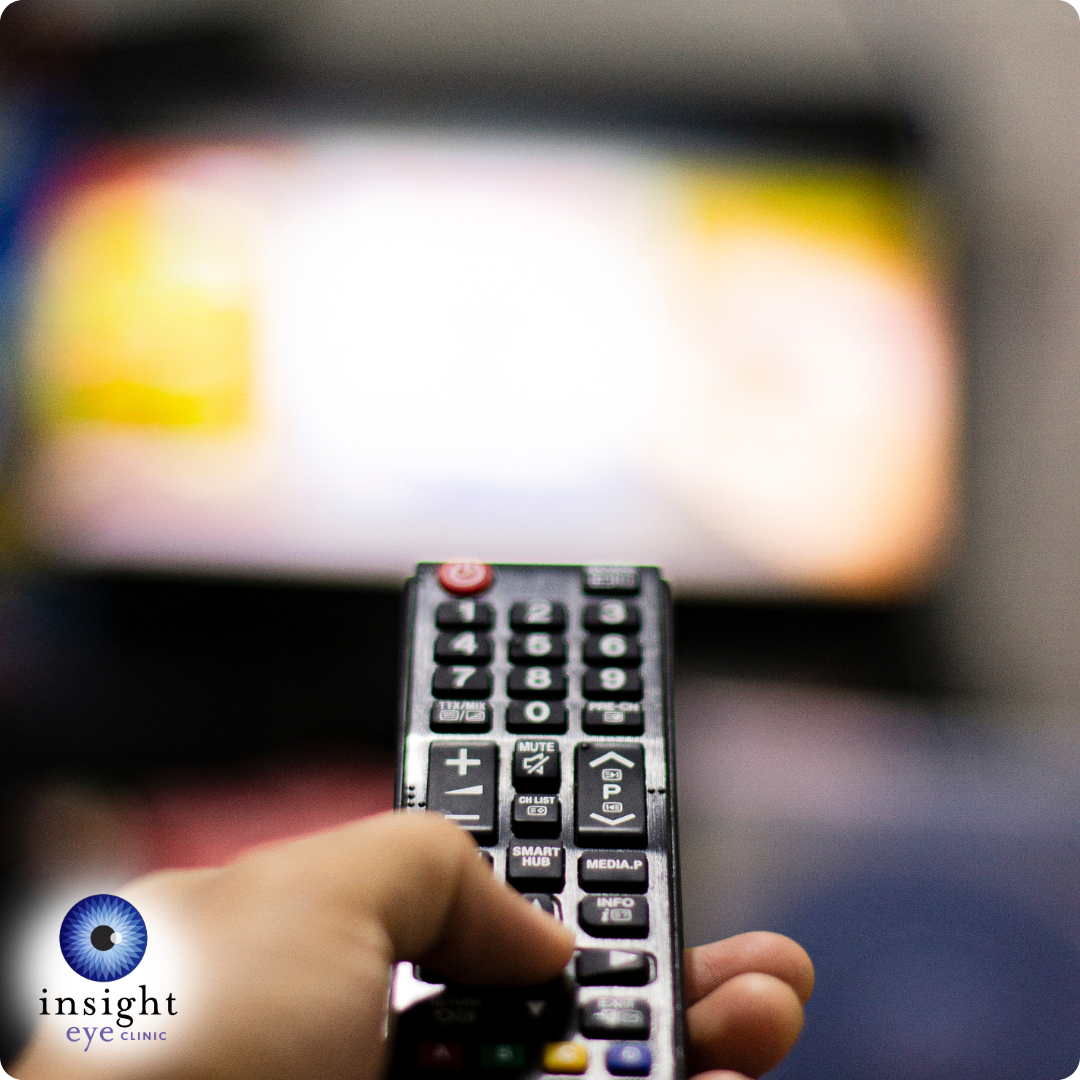 Short-sightedness, medically known as myopia, means that you can usually see objects close to you clearly, while things further away appear blurred. It occurs when light entering the eye focuses in front of the retina rather than directly onto it.
 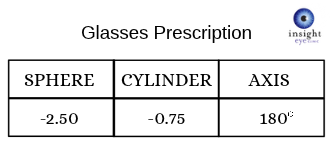 But when we assess somebody for vision correction, we don’t simply look at that first number (sphere). There are another two measurements that are usually populated on most prescriptions. There are ‘cyl’ which is short for cylinder and ‘axis’. Those 2 additional measurements combined tell professionals what your level of astigmatism is.
 Glasses
Contact lenses
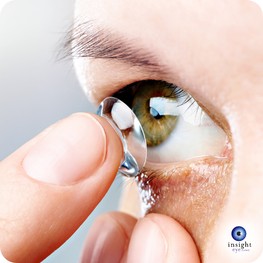 Contact lenses are another effective option for many people and can be particularly useful for sport or occasions when you don’t want to wear glasses.
 SMILE Laser Eye Surgery
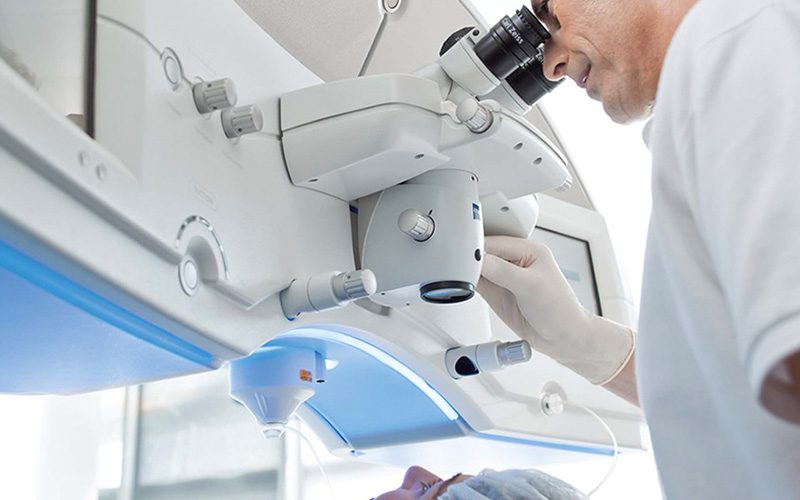 SMILE laser eye surgery is a third-generation laser vision correction procedure and one of the main treatments we use at Insight Eye Clinic for short-sightedness and astigmatism.
 LASIK
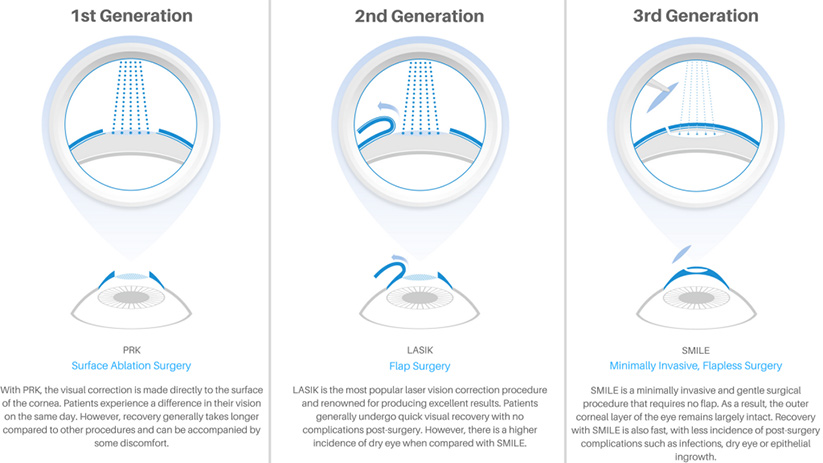
PRK
What happens when the prescription becomes higher?
Higher prescriptions: ICL
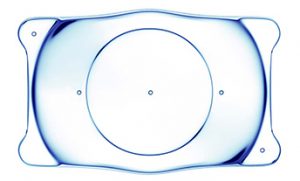 An Implantable Contact Lens, or ICL, is a specially designed lens placed inside the eye (between the iris and natural lens) while leaving the natural lens in position.
 Where does RLE fit in?
 At Insight Eye Clinic, RLE is typically considered for patients aged 45 and over.
 So which surgery suits which prescription?
Which procedure suits your prescription?
 You might expect there to be a simple chart saying:
*Please note: This is a blog and should never be used in place of a Doctors or healthcare professionals advice unless specifically advised
What is Better than LASIK Laser Eye Surgery
Laser Eye Surgery – Google’s 21 Most Popular Questions
Is Laser Eye Surgery Worth It?
Implantable Contact Lens
Extended Depth of Focus (EDoF) Lenses