Vision Correction Options (refractive surgery)
We will all experience or hear of the limitations of both imperfect vision and refractive aides. Whether this is fogging of the glasses behind a theatre mask, or the loss of peripheral vision detail when trying to sink that crucial long putt; or maybe surfing or sailing with the risk of sudden blurred vision due to a lost contact lens or salt sprayed glasses?
Refractive surgery might avoid the frustration of being unable to read a text message until you have found your readers, or the embarrassing moment in the spa when you have hugged the wrong person! The opportunity to achieve good quality spectacle-free vision exists for most people.
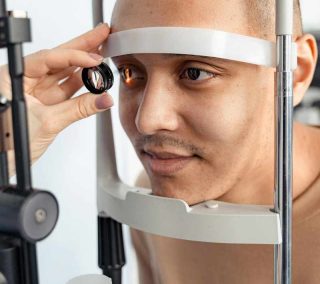 Refractive Error
The need for glasses or contact lenses may develop by our teens or early twenties, due to myopia (weak distance vision), hyperopia (weak near vision) or astigmatism. This is due to the lens system of the eye (cornea + lens) not forming a focused image at the retina. By age 50 most have lost the ability to adjust between distance and near focus (presbyopia, or stiff lens). During our 60s and 70s, lens opacity (cataract) can impair spectacle vision.
Refractive Surgery Overview
Refractive surgery offers a highly effective solution for correcting common vision problems such as myopia (short-sightedness), hyperopia (long-sightedness) and astigmatism. These procedures can significantly reduce, or in many cases eliminate, the need for glasses or contact lenses.
Treating presbyopia, the age-related decline in near vision that typically develops after the age of 45, is more complex. While modern refractive procedures can greatly reduce dependence on reading glasses, they cannot fully restore the eye’s natural ability to focus seamlessly at all distances. As a result, many patients over 50 achieve a high degree of spectacle independence, although vision may not be quite as crisp across all distances as it would be with optimal spectacle correction.
The most commonly performed refractive procedures, each supported by extensive clinical experience and proven long-term outcomes, include:
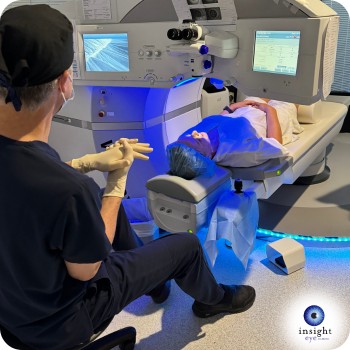 Laser Vision Correction
• SMILE (Small Incision Lenticule Extraction): A minimally invasive procedure in which a small piece of corneal tissue (lenticule) is removed through a tiny incision to reshape the cornea and correct vision.
• PRK (Photorefractive Keratectomy): Laser treatment is applied directly to the corneal surface after the outer layer of cells is removed.
• LASIK (Laser-Assisted In Situ Keratomileusis): A thin corneal flap is created, laser treatment is performed beneath the surface, and the flap is then repositioned.
• Implantable Contact Lenses (ICL)
A specially designed lens is placed inside the eye without removing the natural lens. This option is often suitable for patients with higher prescriptions or those who are not ideal candidates for laser vision correction.
Refractive Lens Exchange (RLE)
The eye’s natural lens is replaced with an artificial intraocular lens (IOL), similar to cataract surgery. RLE is commonly recommended for patients over 45 seeking greater freedom from glasses while also addressing age-related focusing changes.
The most appropriate treatment depends on several factors, including age, prescription, corneal characteristics, overall eye health and individual visual goals. A comprehensive assessment is essential to determine the safest and most effective option for each patient.
Age-based choices
Refractive lens exchange (RLE) vision correction is stable long-term, and avoids the need for cataract surgery later, but it disturbs any natural accommodation under age 50. Therefore RLE rarely is considered under age 45.
Laser vision correction
SMILE, LASIK and PRK are the most commonly used corrections for the pre-presbyopic age group. Advantages include bilateral same day surgery, and retained near vision adjustment until near the age of 45. SMILE and LASIK have minimal discomfort and enable return to work after 2-3 days, while PRK has more discomfort and requires 1 week to return to work. PRK is far less likely to induce dry eye or corneal warpage (ectasia) and post-operatively there is less risk of significant injury with minor corneal trauma.

Presbyopic solutions (reading vision)
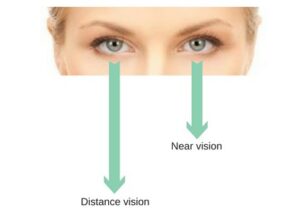 After the age 45-50, correcting distance vision in both eyes leaves near vision that requires glasses. Natural lens changes will eventually cause a decline in distance vision in both laser correction and phakic lens implant. This favours the use of refractive lens exchange (RLE) for stable long term results.
RLE is essentially a cataract operation done before any visually significant opacity of the lens has developed. There are several choices of replacement intraocular lenses.
Monofocal lens implants can be chosen to correct each eye for distance vision (requiring glasses for clear near vision), or alternatively the dominant eye is corrected for distance and the non-dominant eye for near vision. This monovision configuration can provide independence from spectacles and is very effectively demonstrated by temporary use of contact lenses, ensuring good understanding of what is achievable.
Multifocal lens implants achieve balanced bifocal vision in both eyes. Halo and glare and limited intermediate vision clarity (e.g. computer screen) can occur and are difficult to demonstrate pre-operatively. Occasionally; halo and glare intolerance may require bilateral monofocal intraocular lens exchange.

Additional Blog Posts Related to Your Interests
Laser Eye Surgery – Google’s 21 Most Popular Questions
How To Get Rid of Reading Glasses
Presbyopia – What is that?!