Cataracts: The Different Types




Cataracts are the leading cause of blindness in the world today with an estimated 17 million people blind in both eyes. Sadly, not everyone suffering from blindness caused by cataracts has access to a healthcare system which can provide government funded surgery to cure them of this debilitating disease.
We want to tell you about the 3 primary types of age-related cataracts and related symptoms. Hopefully, this information will help you recognise early signs and prompt you to get an eye health check by your Optometrist or nearest eye health provider.
Visual complaints associated with cataracts are as follow:
• Clouded, blurred or dim vision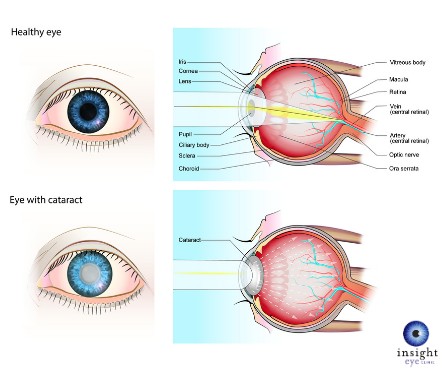
• Increasing difficulty with vision at night
• Sensitivity to light and glare
• Need for brighter light for reading and other activities
• Seeing “halos” around lights
• Frequent changes in eyeglass or contact lens prescription
• Fading or yellowing of colours
• Double vision in a single eye
Cataract – Nuclear Sclerosis
A nuclear sclerotic cataract is when there is a hardening and yellowing in the centre (nucleus) of the natural lens which sits just behind the iris inside of the eye. A nuclear sclerotic cataract progresses slowly and may require many years of gradual development before it begins to affect vision. If left untreated, can cause blindness.
Cataract – Cortical Spokes
A cortical cataract is characterized by white, wedge-like opacities that start on the outer edges of the lens and work their way to the centre having the appearance of a wheel spoke or star like pattern. This type of cataract occurs in the lens cortex, which is the part of the lens that surrounds the central nucleus.
People with diabetes are most likely to be effected by this type of cataract.
Cataract – Posterior Subcapsular
Posterior subcapsular cataracts begin as a small, cloudy or opaque area on the back, or posterior, of the lens. People with diabetes or those taking a high dosage of steroids are likely to develop a posterior subcapsular cataract. Extreme nearsightedness, and/or retinitis pigmentosa may develop this type of cataract. Subcapsular cataracts can develop rapidly and symptoms can become noticeable within months.
How You can Treat Cataracts
Treatment for cataracts is to remove the affected lens and replace it with an artificial lens. Modern artificial lenses and varied ocular arrangements mean that you might not require glasses at all after surgery!
Monofocal lenses – distance vision
A monofocal IOL can provide clear distance vision in both eyes. Patients choosing this option will generally require glasses for reading and other close work. For some patients, this provides excellent quality of vision with a simple and predictable visual strategy.
Monovision or blended vision
With monovision, one eye is generally targeted more towards distance vision and the other towards nearer vision. The brain combines the information from both eyes, potentially reducing dependence on glasses across a broader range of activities.
Not everyone adapts comfortably to this difference between the eyes, which is why a contact lens trial may be recommended before surgery for some patients.
Extended Depth of Focus (EDOF) lenses
EDOF intraocular lenses are designed to extend the range of clear vision, generally providing strong distance vision with improved intermediate vision for activities such as computer work, dashboards, shopping and many everyday tasks.
They can offer greater spectacle independence than a standard monofocal lens while maintaining an emphasis on quality distance and intermediate vision. Reading glasses may still be required for smaller print or prolonged close work.
Trifocal lenses
Trifocal IOLs are designed to provide vision across distance, intermediate and near ranges and can offer a high degree of independence from glasses.
As with all premium IOLs, they are not suitable for every eye. Some patients may experience visual effects such as halos or glare, particularly around lights at night, so careful assessment and discussion of lifestyle and expectations are important.
There is no single “best” intra-ocular lens for every patient. The most appropriate IOL depends on your eye health, measurements, lifestyle, visual priorities and tolerance for the compromises associated with different lens technologies.
Common Cataract Concerns & Questions Part 1
FineVision Trifocal Intraocular Lenses